






Written by Maria Mocerino
Edited by Nicki Steinberger, PhD
EDITOR’S SUMMARY: Anti-aging research spans a strange range: from experiments exploring how young and old circulatory systems affect biological aging to familiar treatments like Botox and everyday ingredients such as retinoids and vitamin C. Yet beneath the multibillion-dollar pursuit of younger-looking skin lies a more unexpected reality: scientists still don’t fully understand how skin ages. Research into oxidative stress, chronic inflammation, collagen breakdown, glycation and stem cells is revealing more about what happens beneath the surface, while also helping separate what anti-aging products and treatments can actually do from what their marketing promises.
In 2025, researchers led by Beiersdorf AG, the skincare company that owns NIVEA and Eucerin, set out to investigate a peculiar finding from aging research: older animals surgically joined to younger ones through a shared circulatory system have shown signs of tissue rejuvenation. Known as heterochronic parabiosis, these experiments have suggested that factors circulating in younger blood may influence biological aging, but exactly how remains unclear. Rather than repeat the animal experiment, the Beiersdorf researchers created a laboratory system combining human skin and bone marrow models and exposed it to serum from younger or older people. Young serum alone did not rejuvenate the skin model; the effect emerged only when bone marrow-derived cells were also present. The finding pointed researchers toward bone marrow as an important intermediary between circulating factors and changes in aging skin.
Considering the lengths taken to extend life and maintain a youthful appearance, it might come as a surprise that science still doesn’t have a complete picture of aging at the cellular level. The skin is no exception. As the 2023 review “Research Progress on Skin Aging and Active Ingredients” put it, “The mechanisms of skin aging and effective compounds or products against skin aging are not well understood.”
Advances in the science of aging have brought new attention to the field in recent decades. In 2009, the Nobel Prize in Physiology or Medicine recognized earlier discoveries showing how chromosomes are protected by telomeres and the enzyme telomerase. Often compared with the plastic aglets that keep shoelaces from unraveling, telomeres generally shorten as cells divide, helping researchers understand one of the mechanisms associated with cellular aging. Richard Hodes, Director of the National Institute on Aging, said in an interview with his alma mater, Harvard Medical School:
“The conclusion of a great many such analyses led to the realization that physiological aging differs from person to person. If you fine-tune the parameters of what aging means at a molecular level, you find that molecular variations also differ from person to person and that these interpersonal variations get greater with age.”
As people live longer, understanding what drives aging, and what might slow some of its effects, has taken on greater importance. That includes the body’s capacity for repair. As researchers investigate how tissues deteriorate over time, stem cells have become an important part of the picture because of their role in maintaining and regenerating tissue. But before considering what they might offer aging skin, it helps to understand what is happening in the skin itself.
What Is Skin Aging?
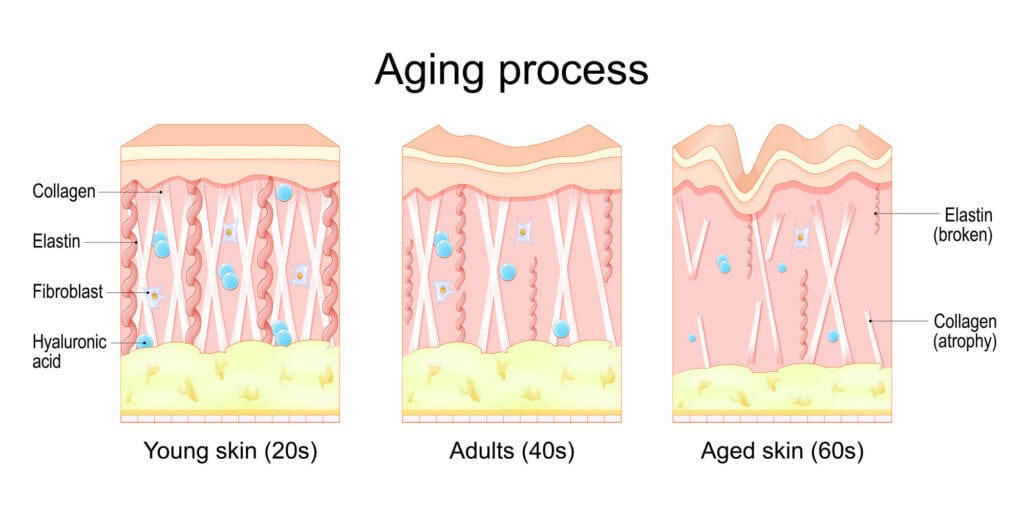
Current science suggests that free radicals, oxidative stress, chronic inflammation, photoaging and glycation all contribute to skin aging. Free radicals are highly reactive molecules produced both through normal cellular metabolism and in response to environmental factors such as UV radiation and air pollution. In controlled amounts, they participate in normal cellular processes. But when their production overwhelms the body’s antioxidant defenses, the resulting imbalance is known as oxidative stress. Other factors that can contribute include smoking, chronic psychological stress and metabolic disturbances associated with diets high in refined sugars and heavily processed foods. Mitochondria, which generate much of the energy cells use, are both a source and a target of this oxidative activity, linking them closely to the aging process. In other words, some of the forces that shape how skin ages originate inside the body, while others come from everyday exposures and habits.
Inflammation is part of the body’s normal response to injury or threat. But when it becomes chronic, the same protective process can contribute to tissue damage and disease. It also has a complex relationship with cellular senescence, the state in which damaged or aging cells stop dividing but remain metabolically active. Rather than simply becoming passive, senescent cells can release inflammatory molecules that affect surrounding tissue. As Richard Hodes explains, “They have an abnormal phenotype that includes the production of a lot of inflammatory proteins.”
In the skin, chronic inflammation can contribute to collagen breakdown and other changes associated with aging. Research suggests that inflammation can lead to “the degradation of collagen, resulting in relaxation and wrinkles.” Xiaoqing He and colleagues conclude that “inhibiting skin cell inflammation is, therefore, one of the important strategies to control skin cell aging.”
There’s a reason collagen has become such a familiar word in the anti-aging market. Collagen is a major structural protein in the skin, helping provide strength and support, but its production and organization change with age while existing collagen is increasingly broken down. That has made preserving or stimulating collagen a major target of anti-aging research. Hydrolyzed collagen supplements take a different approach: they contain smaller collagen peptides, and clinical research suggests supplementation may improve measures such as skin hydration and elasticity. Exactly how much those effects translate into visible changes in aging skin, however, continues to be studied.
Skin photoaging results largely from cumulative UV exposure over time. Sunlight isn’t the enemy: moderate sun exposure supports vitamin D production, mood and overall health. But repeated UV damage can accelerate visible skin aging. One way it does so is by increasing the activity of matrix metalloproteinases (MMPs), enzymes that break down collagen and other structural proteins in the skin. The goal isn’t to avoid the sun completely, but to reduce excessive exposure and prevent burns. Shade, protective clothing, hats and sunscreen can all help limit UV damage.
MMPs are a family of enzymes involved in remodeling the extracellular matrix, including the breakdown of proteins such as collagen and elastin. Their activity is normally kept in balance by natural inhibitors in the body. When that balance shifts toward excessive MMP activity, collagen can break down faster than it is replaced, weakening the structural framework that helps give skin its strength and elasticity.
Glycation is a chemical reaction in which sugars bind to proteins or fats without the help of an enzyme. Over time, this process can produce advanced glycation end products (AGEs), compounds that alter the structure and function of those proteins or fats. In the skin, their accumulation can make collagen fibers stiffer and less flexible and may also stimulate MMP activity, further contributing to changes in skin structure.
The Power of Stem Cells
The Beiersdorf study brings stem cells back into the picture. Stem cells are central to the body’s ability to maintain and repair tissues because they can both renew themselves and develop into specialized cell types. Two populations frequently studied in regenerative medicine are hematopoietic stem cells (HSCs), found primarily in bone marrow, and mesenchymal stem cells (MSCs), found in bone marrow and other tissues. HSCs give rise to the body’s blood cells, while MSCs can develop into several types of connective-tissue cells, including bone, cartilage and fat cells. As these stem-cell populations and the environments that support them change with age, researchers are investigating what role they may play in tissue aging and repair.
Current studies are exploring whether stem cell therapies could eventually help address aspects of aging by regenerating or replacing damaged tissue. In the Beiersdorf study, the rejuvenating effects of young serum on the human skin model appeared only in the presence of bone marrow-derived cells, suggesting that these cells help mediate the effects of circulating factors on the skin. Previous research has also shown that bone marrow stem cells can migrate to the skin and contribute to its repair and maintenance. An overview of recent related clinical trials defines the aging process as “a decline in the regenerative potential of stem cells,” while also describing aging as a dynamic process involving an interconnected system of biological changes.
This kind of research, still years from a bottle or a clinic, also provides context for the range of approaches already available in the anti-aging market. Some intervene directly to produce a specific cosmetic effect. Botox, for instance, works by blocking the release of a chemical messenger at the junction between nerve and muscle, temporarily relaxing the small muscles that contribute to expression lines. Dermal fillers take another approach, restoring lost volume, often with hyaluronic acid, a substance also found naturally in the skin’s extracellular matrix. These procedures can produce visible results relatively quickly, but they work through very different mechanisms from the cellular processes involved in skin aging.
Topical and lifestyle approaches work differently, often aiming to protect or influence biological processes already at work in the skin. Rather than making one option inherently better than another, understanding those differences makes it easier to ask what a particular treatment or product can realistically accomplish, how it works and what evidence supports it.

Supporting Skin as It Ages
With a sharper picture of how skin ages, it becomes easier to understand what different anti-aging products are actually designed to do. Many active ingredients used to address different aspects of skin aging target processes such as oxidative stress, inflammation and collagen deterioration. Even a familiar term like “antioxidant” takes on clearer meaning when considered in that context.
Retinoids, peptides, vitamin C and glycolic acid have been studied for their potential roles in addressing signs of skin aging, including effects on collagen production, pigmentation and skin texture. Rather than expecting one ingredient to address every aspect of aging, knowing the biological process behind a particular concern can help clarify which ingredients may be relevant and whether the evidence supports the claims made for them. Diet may also influence glycation. Foods and plant compounds studied for potential anti-glycation effects include rosemary, green tea, berries and pomegranates, while cooking methods such as steaming and boiling can reduce AGE formation.
Preserving skin health doesn’t necessarily require an elaborate anti-aging regimen. Some of the most practical approaches involve supporting the skin’s existing defenses: avoiding excessive UV exposure and burns, protecting the skin barrier with gentle cleansing and adequate moisture, not smoking, exercising regularly and eating a nutrient-rich diet. Rather than reversing aging, these everyday practices may be better understood as ways to reduce avoidable damage and support the skin as it ages.
For all the language of “fighting” time and combating skin aging, aging itself is not a disease. The choice to soften its visible signs, embrace them or land somewhere in between is a personal one. What science can offer isn’t a verdict on how anyone should look, but a clearer understanding of what is happening beneath the skin. And while that research is still evolving, knowing more about those processes offers something more useful than another promise of youth: a way to distinguish what sounds good from what the evidence actually supports.
~
Published on October 01, 2026.
If you’ve found value in this article, please share it!
To support the research and health education of AVFC editorial, please consider making a donation today. Thank you.