






By Kirsten Steinman
EDITOR’S SUMMARY: Your almond milk stays smooth. Your salad dressing stays blended. Gellan gum is one ingredient food manufacturers use to create that consistency. Food-safety authorities have found no major concerns at estimated levels of consumption, but questions remain about its composition and how long-term exposure may affect the gut. Different forms can contain residual PHB, proteins and enzymes, while research into gellan gum’s interactions with the microbiome is still developing.
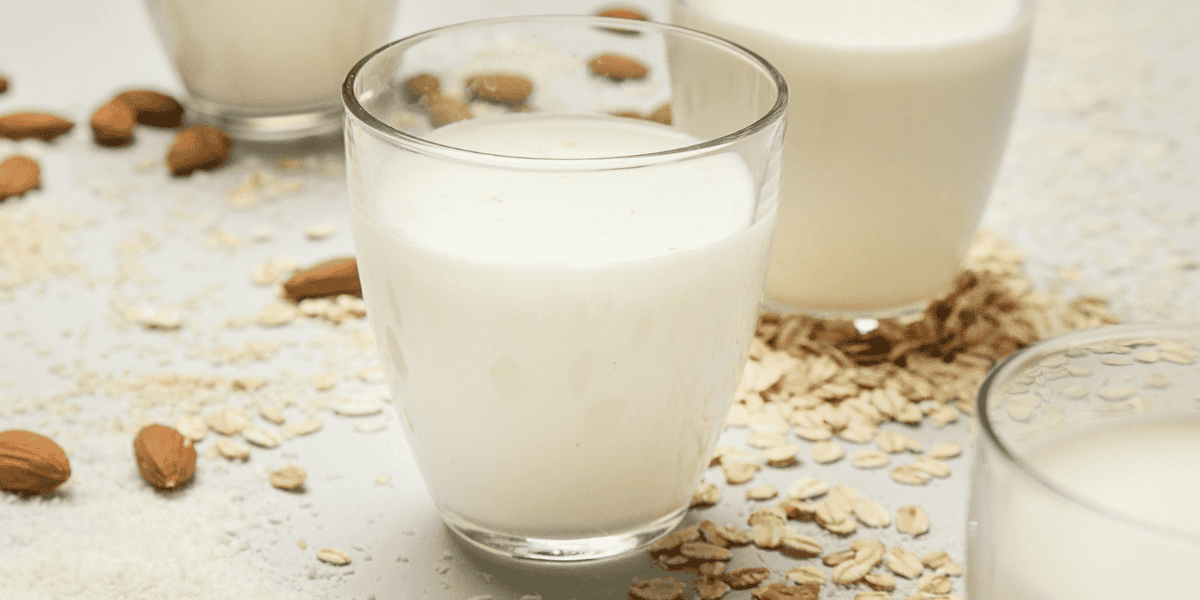
You wake up late and rush out the door. You’re grateful for that can of oat milk mocha that’s been sitting overlooked in the refrigerator for weeks. You don’t have to shake it. Nothing has settled to the bottom. The creamy mouthfeel is consistent, the texture is smooth and the froth is exactly as you expect it to be. That consistency is no accident; it’s a product of modern food formulation. Today’s processed foods and beverages are designed to hold their shape, retain moisture, remain evenly dispersed and maintain a consistent structure from the first sip to the last. Food gums, modified starches, emulsifiers and other hydrocolloids—substances with water-attracting and gel-forming properties that help control the physical characteristics of food—make this possible. They allow manufacturers to create foods that are shelf-stable, visually appealing and remarkably predictable.
One of these ingredients is gellan gum, a relatively modern food additive that has become particularly common in plant-based and fortified foods. It can be found in everything from almond and soy milk to plant-based yogurts, beverages, sauces, jams and desserts. It does its job so well that you may never realize it’s there. But what exactly is gellan gum, why is it used so extensively and how might it affect your body?
How Gellan Gum Works
Unlike traditional gums, such as acacia, which are harvested from plants, gellan gum is produced through microbial fermentation. It was developed in the 1970s after researchers discovered that the bacterium originally classified as Pseudomonas elodea could produce a useful polysaccharide (a large carbohydrate molecule made of repeating sugar units) during fermentation. The organism is now known as Sphingomonas elodea. The resulting substance is separated, purified, dried and processed into a powder.
While gellan is sometimes referred to as a “natural” gum, it belongs to a broader shift in food technology toward microbially produced hydrocolloids. Rather than providing substantial nutrition themselves, these ingredients are used to control consistency, stability, viscosity and structure. Why do manufacturers need it? Altering a food changes its physical behavior. Remove the milk or cream from a dairy product and you lose some of the fat and protein that naturally contribute to creaminess and stability. Remove eggs and you lose richness and structure. Fortify the product with vitamins and minerals and you introduce particles that can settle.
Gellan gum helps solve these problems. Compared to other gums on the market, it is remarkably versatile and can be produced in diverse forms with distinct characteristics. High-acyl gellan tends to create softer, more elastic gels, while low-acyl gellan produces firmer, more brittle gels. These different types allow food scientists to engineer textures ranging from creamy and spoonable to firm and clean-breaking, including gels that are set firmly enough to be cut with precision, leaving a smooth, clean edge.
At very low concentrations, gellan can also create a microscopic network that helps suspend particles throughout a liquid. For example, a fortified beverage may contain particles of calcium, protein, vitamins or other minerals that can accumulate and sink. Gellan helps keep them evenly dispersed, so you don’t end up with a watery drink on top and a thick layer of sediment on the bottom. That same network can also add body and thickness, helping create a smooth, consistent mouthfeel even in beverages with relatively little solid material. This makes gellan especially valuable in foods marketed as lower-fat, lower-calorie or fortified.
Seeing “organic” on the label doesn’t necessarily mean the product is free of gellan gum. Under USDA organic standards, high-acyl gellan gum is permitted as a nonagricultural, nonorganic ingredient in processed organic foods. That’s because products labeled “organic” can contain certain nonorganic substances included on the National List of Allowed and Prohibited Substances. So even if you deliberately choose organic foods, you may still find gellan gum on the ingredient list.
Gellan gum can perform some of the same physical functions as gelatin and so is often used as a replacement. However, the two ingredients are fundamentally different. Gelatin is a protein derived from collagen. It contributes amino acids that help support joint, skin and connective tissue health, including glycine, proline and hydroxyproline. Gellan gum, on the other hand, is a polysaccharide used primarily for technological purposes in food formulation. At the smaller quantities typically used, it does not provide meaningful protein, fats or carbohydrates. While it might keep calcium suspended in a plant-based beverage or provide structure to a dessert, it doesn’t contribute the same nutritional value that gelatin does.
What Regulators Say
This naturally prompts the question: is gellan gum safe? And what happens when you consume it regularly? So far, the answer from food-safety authorities has been reassuring. Gellan gum was first evaluated by the Joint FAO/WHO Expert Committee on Food Additives (JECFA) in 1990. The toxicological assessment included acute and repeated-dose testing as well as long-term studies. JECFA ultimately assigned gellan gum an acceptable daily intake, or ADI, of “not specified.” This designation is used when, based on the available evidence and expected use levels, a numerical daily intake is not considered necessary. JECFA did note that high intakes could have a stool-loosening effect in some people.
The safety studies included research in rats, dogs and monkeys. In a 90-day rat study, researchers found no harmful effects at very high levels of the additive in the diet (up to 60,000 mg/kg of feed). A year-long study in dogs likewise found no adverse effects at the highest amount tested. Investigators also conducted a human tolerance study in which participants consumed high amounts of gellan gum for about three weeks. No significant harmful effects were reported, although JECFA noted that the participants did experience an increase in the size, weight and firmness of stool (consistent with gellan gum’s potential laxative effect).
These findings are positive, considering that the amount of gellan found in a single serving of food is much smaller than the amounts used in the research. However, when it comes to long-term consumption, they don’t answer every question. The toxicology investigations were primarily designed to identify conventional hazards such as organ toxicity, reproductive effects, mutations and cancer. They were not intended to assess what might happen to the human microbiome after decades of daily exposure.
A closer look at what exactly is being called “gellan gum” raises another issue. In 2018, the European Food Safety Authority (EFSA) re-evaluated the food additive and concluded that the available evidence did not point to a safety concern at estimated dietary exposures. But the assessment did unearth a less obvious issue: the term “gellan gum” does not refer to a single, uniform material with a consistent composition.
Gellan can occur in high-acyl and low-acyl forms, and low-acyl products may be clarified or non-clarified. Different manufacturing processes can affect the structure and characteristics of the final ingredient. Meanwhile, a toxicological study can only reveal information about the material that was actually tested. If different commercial mixtures contain varying amounts of residual fermentation products, then it’s not scientifically accurate to simply call all of them “gellan gum.” For this reason, EFSA has called for tighter specifications and better characterization of the ingredient and its potential remaining components.

The Purity Problem
One unusual substance that can remain after gellan production is a microbial polyester called poly-beta-hydroxybutyrate, or PHB. This compound is a natural storage material that some bacteria make and store inside their cells when nutrients are plentiful. Because gellan gum is produced using bacteria, PHB can remain in the finished material after fermentation. Manufacturers attempt to remove PHB through purification processes, including alcohol precipitation and pressure filtration. EFSA reported that PHB concentrations in samples of gellan gum ranged from less than 1% to as much as 25% of the material in some preparations.
The variability raises an important question about the toxicology studies used to establish its safety: how closely did the material tested in those studies resemble the material used in food? EFSA noted:
“No information was available on the purity of the test material in these studies, including the concentration of PHB.”
The Panel on Food Additives and Nutrient Sources Added to Food (ANS Panel) found that “PHB may be a major component of the food additive E 418 resulting from the manufacturing process.” While that doesn’t mean a typical container of oat milk has 25% PHB, it does raise a question: how precisely does the term “gellan gum” describe the material being evaluated?
PHB has been increasingly analyzed independently to see whether it can interact with gut microbiomes and microbial metabolites (small chemical molecules produced by microorganisms). Some studies have suggested potentially beneficial effects, including prebiotic-like activity. But the scientific understanding of this area is still emerging and does not establish how residual PHB in commercial gellan gum affects people who consume it. PHB isn’t the only potential residual component. Because gellan gum is made by bacteria, small amounts of proteinaceous (containing or resembling protein) matter from the production organism may remain after processing. EFSA reported protein-related nitrogen levels in some preparations and recommended better characterization of this material.
This is important because proteins can have biological properties that are very different from the gellan polysaccharide itself and can trigger the human immune system to overreact. While EFSA did not find that gellan gum causes allergic reactions in the available studies, the larger issue was one of control—manufacturers should be able to define and check the amount of residual protein present in the finished ingredient.
This same principle applies to the bacterial enzymes that are naturally produced by the organisms used to make gellan gum, including amylases, cellulases and proteases. Manufacturing procedures are designed to remove or deactivate these residual enzymes, but EFSA found limitations in the available information about their presence and activity. Just as with the proteins, this is not evidence that the enzymes are harmful, but another example of gaps in the characterization of gellan gum’s composition.
One of the biggest unanswered questions is this relatively modern food additive’s effect on the trillions of microorganisms living in the human gut. EFSA concluded that “gellan gum is unlikely to be absorbed intact and would not be fermented by human intestinal microbiota.” In other words, the available evidence suggests that much of the intact polymer passes through the gastrointestinal tract rather than being extensively broken down by the gut microbiota.
However, there’s an important distinction: not being fermented does not mean a substance is biologically inactive. It can still influence how cells respond or alter conditions in the gut in other ways. Some examples include affecting the thickness or resistance to flow of intestinal contents and the mucus lining, altering how long it takes food to pass through the digestive tract and changing the availability of nutrients or the environment in which microbes live.
A 2022 study published in Food Chemistry, “Gellan Gum Prevents Non-Alcoholic Fatty Liver Disease by Modulating the Gut Microbiota and Metabolites,” explored how gellan gum might affect the microbiome. In laboratory fermentation experiments, the additive promoted the growth of certain bacteria, including Lactiplantibacillus rhamnosus and Bifidobacterium bifidum, and changed the types of compounds produced by the bacteria. The researchers then fed it to mice consuming a high-fat diet. These mice developed different gut microbial communities, produced more short-chain fatty acids and showed improvements in several measures of liver health and fat metabolism. Gellan gum was also associated with changes in the expression of proteins involved in hepatic inflammation and lipid metabolism. Taken together, the researchers wrote that gellan gum “ameliorated non-alcoholic fatty liver disease (NAFLD), possibly by acting on the gut-liver axis via improving the gut health,” suggesting potential prebiotic activity.
Of course, this was not a human clinical trial; it was conducted in the laboratory and in mice. While it shows that gellan gum can interact with microorganisms under experimental conditions, it doesn’t confirm whether the same thing happens in humans consuming ordinary amounts of gellan-containing foods. Science is still trying to determine how gellan gum affects microbiome diversity, whether it increases or decreases certain bacterial species, how it alters microbial metabolites and whether it affects the intestinal barrier. The earlier toxicology studies used to evaluate gellan gum’s safety were not designed to address these issues.
Then there’s an older study from 1997, “Effects of Curdlan and Gellan Gum on the Surface Structure of Intestinal Mucosa in Rats,” that presented a new puzzle: researchers fed rats diets containing gellan gum for four weeks and examined the gastrointestinal tract under an electron microscope. The study found changes in intestinal transit, as well as alterations in the surface structure of ileal and cecal microvilli. Microvilli are tiny finger-like projections on the surface of absorptive cells lining parts of the small and large intestines. The researchers reported that the tops of some microvilli appeared to adhere to one another and were covered by intestinal contents. However, there were no differences in the surface structure of the colonic mucosa (innermost tissue lining of the large intestine) between the gellan, cellulose and control groups.
The uncertainty seems especially important when considering digestive symptoms that can occur after eating packaged foods containing gellan gum. If you’ve ever felt bloated or uncomfortable, it can be tempting to blame the gum. But gellan is rarely consumed in isolation. The same food may contain added fibers, sugar alcohols, protein isolates, fats, sweeteners and other stabilizers, any of which can affect digestion. Any discomfort could stem from gellan itself, another ingredient or several ingredients acting together.
Food gums are often lumped together, but they are not the same. Gellan, xanthan, guar, carrageenan and agar are chemically different substances with distinct structures, sources and behavior in the digestive tract. Some gums are more readily fermented by gut bacteria. Some have been studied more extensively in humans, while others have mainly been investigated in animals or laboratory systems. The distinction also matters nutritionally: a fiber-rich plant food containing naturally occurring polysaccharides is not the same biologically as a purified hydrocolloid like gellan gum that has been added to a beverage in order to modify its texture. The amount consumed, the food matrix (the chemical and physical properties of a food) and your particular microbiome can all influence how an ingredient behaves in your body.

Should You Avoid Gellan Gum?
Food-safety evaluations have not identified major concerns in gellan gum’s toxicological profile. Decades of research have not produced strong evidence of genotoxicity or carcinogenicity at estimated dietary exposure levels. But crucial information gaps still need to be addressed. Gellan gum has not been thoroughly studied in humans, particularly regarding the effects of long-term, repeated exposure on the gut.
At the end of the day, gellan gum is a tool of modern food formulation. It allows manufacturers to remove dairy, reduce fat or sugar and otherwise alter a food’s nutritional composition while preserving the texture and sensory experience that consumers expect. In that sense, it can restore characteristics lost during processing. But what those changes mean for the food’s nutritional value, and what effects the ingredient itself may have beyond its technological function, are more complicated questions.
How you approach gellan gum may depend on the food as a whole, how often you consume it and how your body responds. And when an ingredient starts appearing more frequently in foods marketed as healthier, it’s fair to ask not only whether it’s been shown to be safe but what is actually known about its effects over years of consumption. Food science has become remarkably good at engineering foods to have appealing textures, consistent structure, convenience and shelf stability. But understanding how some of these increasingly sophisticated formulations interact with the body has not kept pace. Until it does, keep looking beyond the label at what the research can—and cannot—tell you.
~
Published on September 24, 2026.
If you’ve found value in this article, please share it!
To support the research and health education of AVFC editorial, please consider making a donation today. Thank you.